

Table of Contents
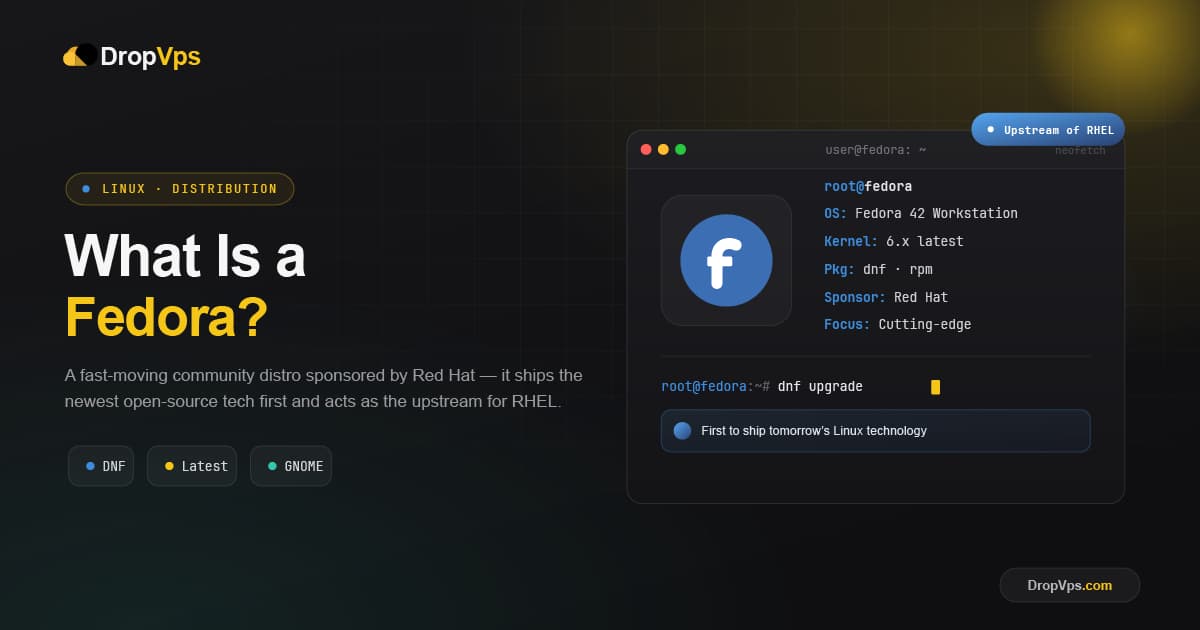
Fedora is a free, open-source Linux operating system sponsored by Red Hat and built by a worldwide community. It is best known for delivering the newest open-source technologies first while staying polished and reliable, which makes it a favorite among developers, sysadmins, and Linux enthusiasts.
Fedora acts as the upstream source for Red Hat Enterprise Linux, so features often appear in Fedora years before they reach enterprise systems. It ships a clean GNOME desktop, uses cutting-edge software, and follows a fast, predictable release schedule.
Quick Facts
| Developer | The Fedora Project, sponsored by Red Hat |
| Latest version | Fedora 44 |
| Release model | New version about every 6 months |
| Default desktop | GNOME |
| Package manager | DNF (.rpm packages) |
Fedora and Red Hat
Fedora is sponsored by Red Hat and serves as its community testing ground. Technologies are introduced and proven in Fedora first, then later make their way into Red Hat Enterprise Linux. Fedora itself stays completely free and is governed by the community, not dictated by a single company.
Fedora Release Cycle
Fedora releases a new version roughly every six months, and each version receives updates for about 13 months. This keeps the system modern without forcing constant upgrades. The current release is Fedora 44, published in April 2026.
Key Features of Fedora
- Leading-edge software: Among the first to ship new kernels, desktops, and developer tools.
- Strong developer focus: Excellent support for containers, programming languages, and virtualization.
- Clean GNOME experience: A near-stock, uncluttered desktop.
- Security built in: SELinux and modern security defaults are enabled out of the box.
- Backed by Red Hat: Professional engineering combined with community development.
Fedora Editions
Fedora is offered in several editions tailored to different uses:
- Workstation: The desktop edition for laptops and PCs.
- Server: A flexible edition for servers and services.
- IoT: Built for edge and Internet of Things devices.
- CoreOS and Silverblue: Container-focused and immutable variants for modern deployments.
What Fedora Is Used For
- Software development with the newest tools and runtimes.
- Daily desktop use for users who want modern features.
- Servers and containers, including on a Linux VPS when you want a Red Hat-style environment.
- Testing tomorrow's enterprise technology before it reaches RHEL.
Fedora 44
Download the latest official Fedora release directly from the Fedora Project.
Download from Official Website →Closing Thoughts
Fedora gives you the newest that open source has to offer, backed by Red Hat's engineering and a strong community. With Fedora 44 as the current release, it is an excellent pick for developers and anyone who wants a modern, forward-looking Linux.

Follow DropVPS on Google
Add DropVPS as a preferred source to see our latest VPS guides and tutorials surfaced first in Google Search and AI Overviews.
Need a Linux Server for This?
Run Debian, Ubuntu, or any Linux distro on DropVPS — fast NVMe SSD, full root access, and 24/7 support. Perfect for everything you just read.
- Full Root Access
- Debian & Ubuntu Ready
- 99.99% Uptime
- 24/7 Support
No commitment · Cancel anytime