

Table of Contents
NoSQL stands for "Not only SQL." It refers to a category of databases that store and manage data without relying on the rigid, table-based structure used by traditional relational databases.
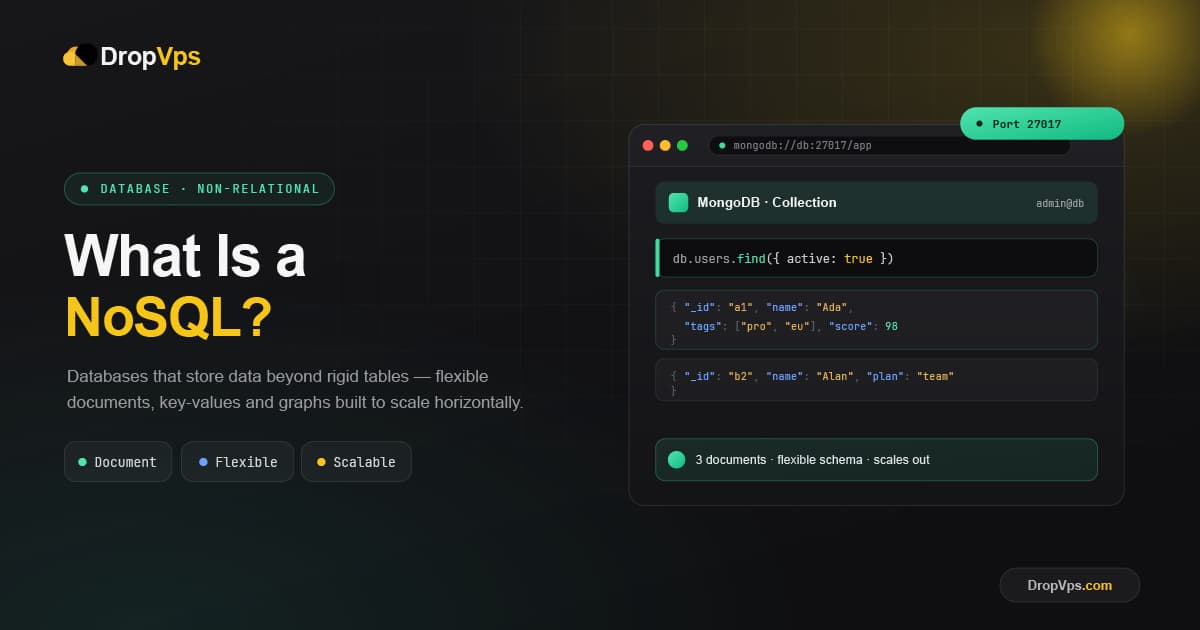
Instead of fixed tables with predefined columns, NoSQL databases use flexible data models such as documents, key-value pairs, wide-columns, or graphs. This makes them well suited to unstructured or rapidly changing data, and to applications that need to scale across many servers.
How NoSQL Works
NoSQL databases use a shared-nothing architecture, meaning there's no single central control unit or storage location. Data is distributed across multiple servers or nodes, which keeps it available even if one node goes down.
Unlike a relational database, a NoSQL database doesn't require a fixed schema. Each record can have a different structure, and that structure can change over time without requiring a full database migration.
Types of NoSQL Databases
NoSQL databases are generally grouped into four main types, each suited to different kinds of data and queries:
| Type | How Data Is Stored | Examples |
|---|---|---|
| Key-Value Store | Each item is a unique key paired with a value | Redis, Amazon DynamoDB |
| Document Database | Data stored as flexible JSON/BSON-style documents | MongoDB, Couchbase |
| Wide-Column Store | Data organized by columns instead of rows | Apache Cassandra, HBase |
| Graph Database | Data stored as nodes and the relationships between them | Neo4j, OrientDB |
A document database, for example, can store a record like this directly, without needing a predefined table structure:
{
  "id": "001",
  "name": "John",
  "role": "Senior Developer",
  "skills": ["Node.js", "MongoDB", "Docker"]
}
SQL vs NoSQL
SQL and NoSQL databases solve different problems, and the right choice depends on the shape of your data and how it needs to scale.
| Aspect | SQL (Relational) | NoSQL |
|---|---|---|
| Data structure | Fixed schema, tables of rows and columns | Flexible schema, varies by type |
| Scaling | Primarily vertical (more powerful server) | Primarily horizontal (more servers/nodes) |
| Query language | Standardized SQL | Varies by database (e.g. MongoDB Query Language, Cypher) |
| Best for | Structured data, complex relationships, transactions | Unstructured/semi-structured data, rapid scaling |
SQL databases provide a uniform data manipulation language across systems, while NoSQL implementations vary depending on the technology, with SQL more common in transactional and analytical applications and NoSQL more common in high-throughput, responsive applications.
What NoSQL Is Used For
NoSQL databases are typically chosen when an application needs flexibility, scale, or a data model that doesn't fit neatly into rows and columns:
Content management systems and product catalogs
Real-time analytics and caching layers
Session storage for web applications
IoT and sensor data at large scale
Social networks and recommendation engines
Fraud detection and pattern discovery (graph databases)
Running a NoSQL database such as MongoDB, Redis, or Cassandra reliably requires a server with enough RAM and fast storage to handle in-memory operations and distributed workloads. A Linux VPS gives you the dedicated resources and root access needed to install and tune a NoSQL database for your application's needs.
Related Guide
Linux VPS Hosting PlansGet a Linux VPS with the RAM and storage performance NoSQL databases need to scale.
NoSQL databases give modern applications the flexibility and horizontal scalability that traditional relational databases weren't built for, making them a core part of how large-scale, fast-moving systems handle data today.

Follow DropVPS on Google
Add DropVPS as a preferred source to see our latest VPS guides and tutorials surfaced first in Google Search and AI Overviews.
Need a Linux Server for This?
Run Debian, Ubuntu, or any Linux distro on DropVPS — fast NVMe SSD, full root access, and 24/7 support. Perfect for everything you just read.
- Full Root Access
- Debian & Ubuntu Ready
- 99.99% Uptime
- 24/7 Support
No commitment · Cancel anytime