

Table of Contents
SQL stands for Structured Query Language. It is a standardized programming language used to create, read, update, and delete data stored in a relational database management system (RDBMS).
Rather than telling a database exactly how to retrieve data step by step, SQL lets you describe what data you want, and the database engine figures out how to get it. This makes SQL both powerful and accessible, since queries read almost like plain English.
How SQL Works
SQL is used to interact with relational databases, where data is organized into tables made of rows and columns, and related tables are linked together through shared keys.
When a query is sent to the database, the system parses it, validates its syntax, optimizes the execution plan, and then runs it against the stored data before returning a result.
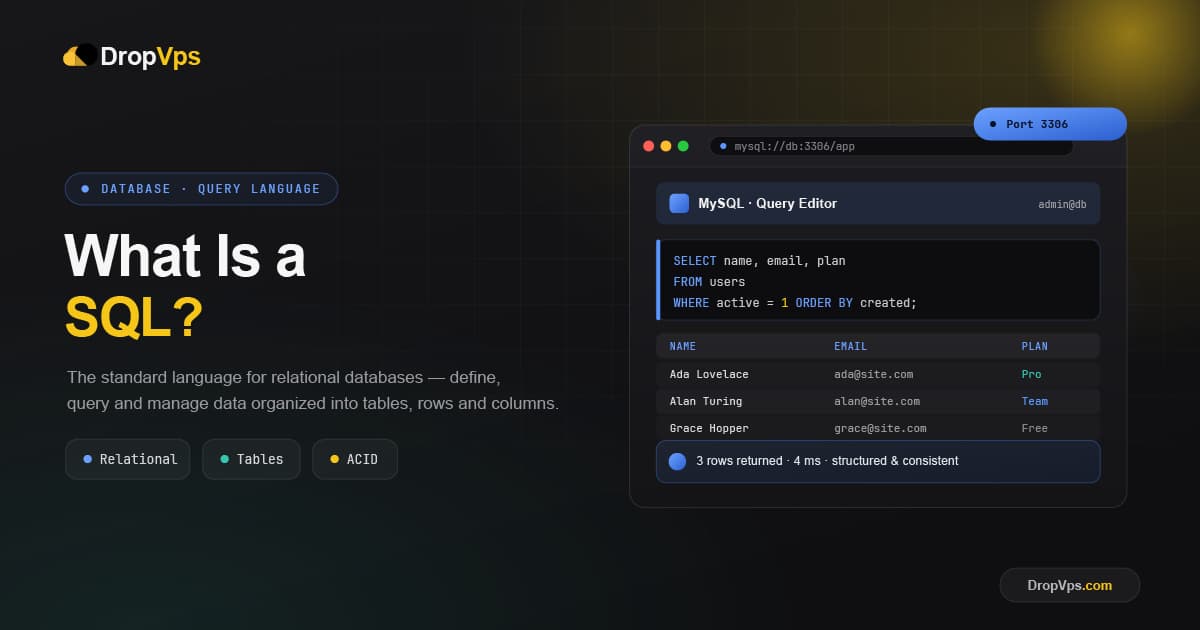
A simple SQL query looks like this:
SELECT name, email
FROM customers
WHERE country = 'USA';
This statement retrieves the name and email of every customer whose country is the USA, without specifying how the database should search the table internally.
Categories of SQL Commands
SQL commands are grouped into a few main categories, based on what they do to the database:
| Category | Purpose | Example Commands |
|---|---|---|
| DDL (Data Definition Language) | Defines and modifies database structure | CREATE, ALTER, DROP |
| DML (Data Manipulation Language) | Adds, modifies, and removes data | INSERT, UPDATE, DELETE |
| DQL (Data Query Language) | Retrieves data from the database | SELECT |
| DCL (Data Control Language) | Manages user permissions and access | GRANT, REVOKE |
Key SQL Concepts
A few core concepts come up in almost every SQL database, regardless of which system you're using:
Table       - a structured collection of rows and columns
Primary Key - a unique identifier for each row in a table
Foreign Key - a column that links to the primary key of another table
Index       - a structure that speeds up data lookups
JOIN        - combines rows from two or more related tables
Transaction - a group of operations executed as a single unit
SQL databases follow ACID properties (atomicity, consistency, isolation, durability), which guarantee that transactions are processed reliably even in the event of errors or system failures.
Popular SQL Database Systems
SQL itself is a language, not a database. Several different database systems implement SQL, each with their own extensions and performance characteristics:
MySQL       - widely used open-source RDBMS, common in web hosting
PostgreSQL  - open-source, advanced features, strong standards compliance
Microsoft SQL Server - enterprise RDBMS built for Windows environments
Oracle Database - enterprise-grade RDBMS used in large organizations
SQLite      - lightweight, file-based database for smaller applications
Most web applications, content management systems, and e-commerce platforms rely on an SQL database running on the backend, which is why database performance is closely tied to the resources of the server hosting it. A Linux VPS with sufficient RAM and fast storage gives a database engine like MySQL or PostgreSQL the resources it needs to run queries efficiently.
Related Guide
Linux VPS Hosting PlansGet a Linux VPS with the CPU and RAM your SQL database needs to run smoothly under load.
SQL remains the standard language for working with structured, relational data, and understanding its core commands is a foundational skill for anyone building or managing data-driven applications.

Follow DropVPS on Google
Add DropVPS as a preferred source to see our latest VPS guides and tutorials surfaced first in Google Search and AI Overviews.
Need a Windows Server?
DropVPS Windows VPS gives you full Admin RDP access, instant setup, and dedicated resources — run any Windows workload without limits.
- Full Admin Access
- RDP Ready Instantly
- Dedicated Resources
- 24/7 Support
No commitment · Cancel anytime