

Table of Contents
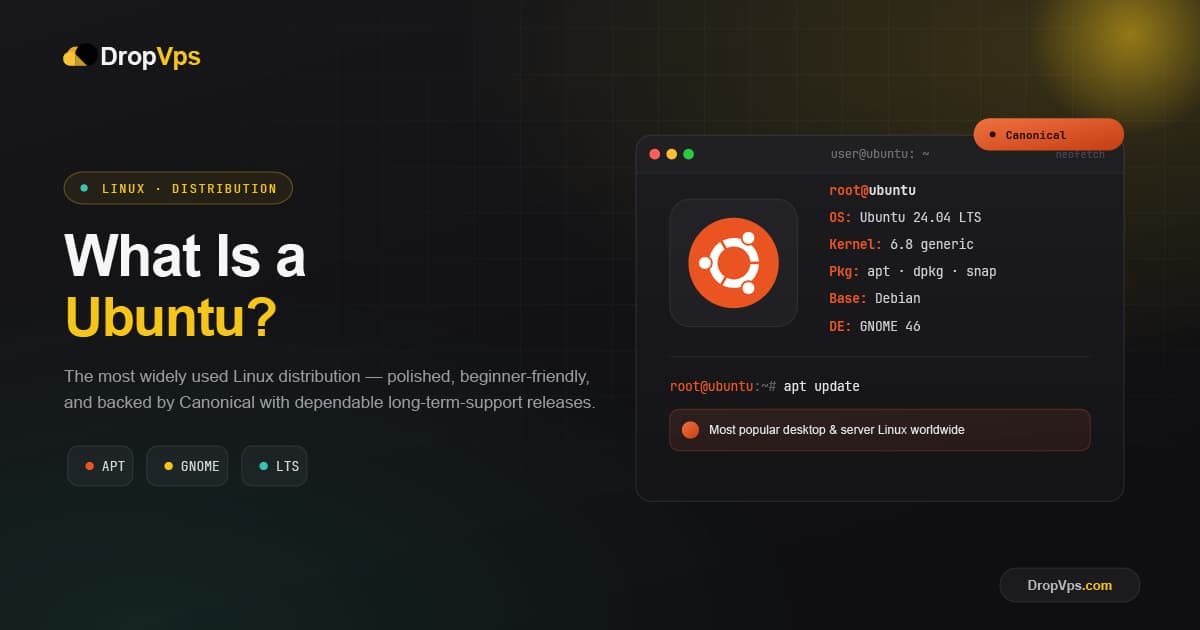
Ubuntu is a free, open-source Linux operating system based on Debian and developed by the company Canonical. It is the most widely used Linux distribution in the world, trusted for desktops, servers, and cloud hosting because it is easy to use, secure, and backed by years of free updates.
Ubuntu combines the stability of Debian with a polished, beginner-friendly experience and a predictable release schedule. It ships with the GNOME desktop, a huge software library, and strong community and commercial support, which makes it a common first choice for both new Linux users and professional system administrators.
Quick Facts
| Developer | Canonical Ltd. |
| Based on | Debian |
| Latest version | Ubuntu 26.04 LTS (Resolute Raccoon) |
| Default desktop | GNOME |
| Cost | Free and open source |
Who Makes Ubuntu
Ubuntu is developed and maintained by Canonical, with help from a global community of contributors. Canonical funds development, provides commercial support, and offers paid services such as extended security maintenance for businesses, while the operating system itself stays free for everyone.
Ubuntu Release Cycle
Ubuntu follows a fixed, time-based schedule with two kinds of releases:
- LTS (Long Term Support): Released every two years in April and supported for 5 years of standard updates, extendable to 10 years with ESM. LTS versions are the recommended choice for servers and production systems.
- Interim releases: Released every six months with newer software and 9 months of support. These suit users who want the latest features.
The current long-term release is Ubuntu 26.04 LTS (Resolute Raccoon), with the older 24.04 LTS (Noble Numbat) still very widely used in production.
Key Features of Ubuntu
- Ease of use: A clean GNOME desktop and simple installer make it approachable for beginners.
- Massive software library: Thousands of packages through APT, plus Snap apps from the Snap Store.
- Security and updates: Regular security patches and long support windows on LTS releases.
- Hardware support: Works on a wide range of laptops, desktops, and servers out of the box.
- Strong community: Extensive documentation, forums, and tutorials for almost any problem.
Ubuntu Editions
Ubuntu comes in a few official editions for different needs:
- Ubuntu Desktop: The standard version with a graphical interface for everyday computers.
- Ubuntu Server: A command-line version optimized for servers, hosting, and the cloud.
- Official flavors: Variants with different desktops, such as Kubuntu (KDE), Xubuntu (Xfce), and Lubuntu (LXQt).
What Ubuntu Is Used For
- Everyday desktop computing for browsing, office work, and development.
- Web servers, databases, and applications, where Ubuntu Server is a leading choice.
- Cloud and VPS hosting: Ubuntu is the most common operating system on a Linux VPS, powering websites, apps, and APIs.
- Software development and containers, with first-class support for Docker, Python, and Node.js.
Ubuntu 26.04 LTS (Resolute Raccoon)
Download the latest official Ubuntu release directly from Canonical.
Download from Official Website →Closing Thoughts
Ubuntu earned its popularity by being free, stable, and genuinely easy to use, from a first-time desktop to a production server. With long-term support releases and the latest 26.04 LTS, it remains the safest default choice for anyone entering the Linux world.
Follow DropVPS on Google
Add DropVPS as a preferred source to see our latest VPS guides and tutorials surfaced first in Google Search and AI Overviews.
Need a Windows Server?
DropVPS Windows VPS gives you full Admin RDP access, instant setup, and dedicated resources — run any Windows workload without limits.
- Full Admin Access
- RDP Ready Instantly
- Dedicated Resources
- 24/7 Support
No commitment · Cancel anytime